Helpmaton Review - AI Agent Management Platform with Predictable Budget Control and Persistent Memory
Helpmaton: Managing AI Agents Like Employees, Not APIs
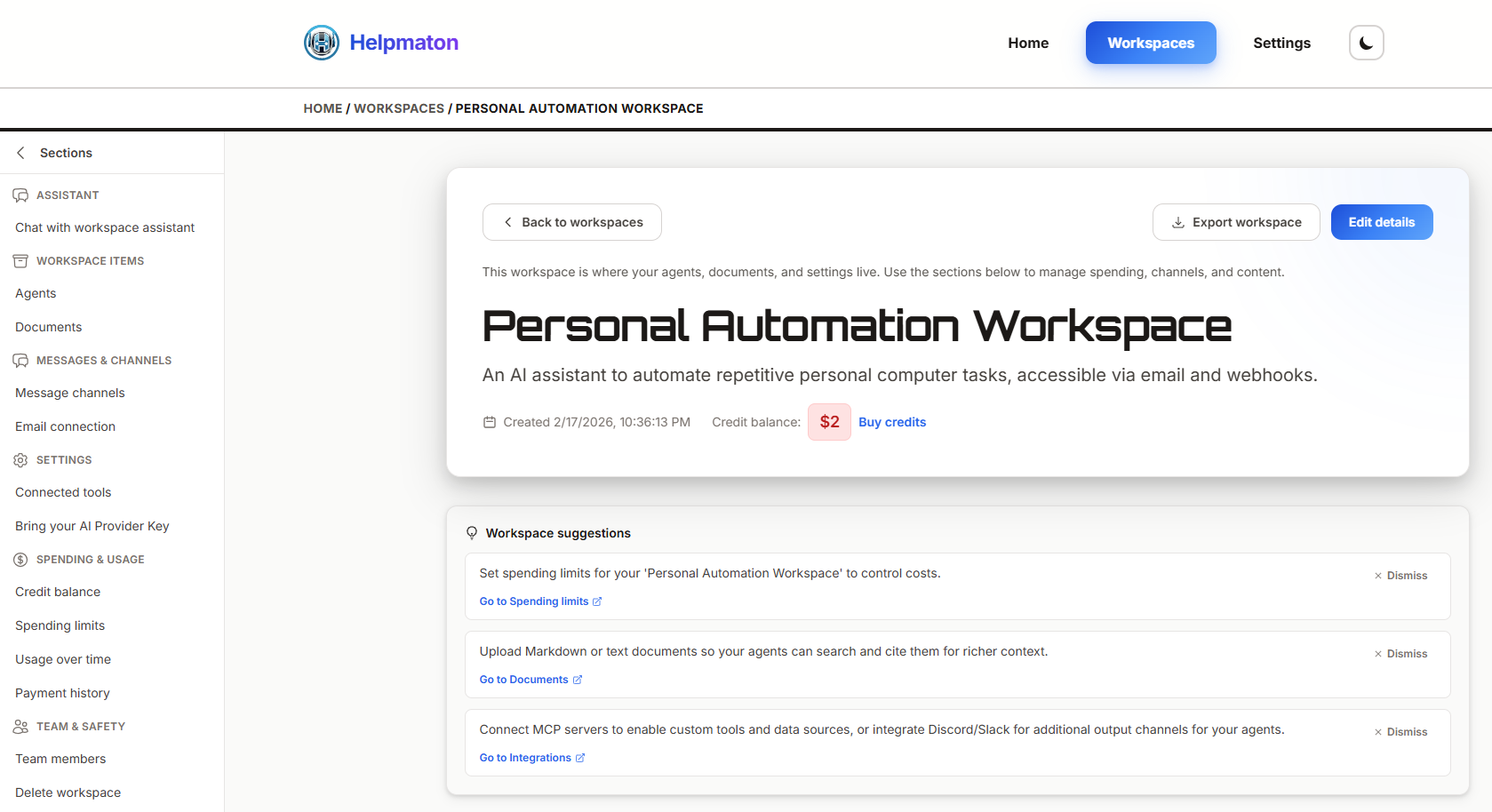
Running AI agents without Helpmaton feels like managing a sweatshop without oversight. Your agents do work, sure, but you have no idea what it costs, whether they're actually competent, or what they remember between conversations.
Helpmaton flips this model: agents become managed entities with budgets, memory systems, quality evaluation, and persistent context.
After testing this with a team deploying autonomous agents across Slack, Discord, and internal tools, I found something valuable: Helpmaton isn't just an orchestration layer—it's the difference between AI feeling chaotic and AI feeling reliable.
The AI Agent Management Problem
Organizations deploying autonomous agents face consistent friction:
- Cost opacity: You deploy an agent and hope it doesn't bankrupt you. No spend controls, no transparency.
- Context amnesia: Each conversation starts fresh. Agents can't build on previous interactions, relationships, or learning.
- Quality unknowns: Is your agent performing well? You have no systematic way to measure this.
- Integration friction: Connecting agents to Slack, Discord, or internal systems requires custom work each time.
- No audit trail: When something goes wrong, you have no visibility into what the agent did or why.
Most teams work around these by limiting agent deployments—essentially making AI agents too expensive and risky to use widely. The opportunity cost is massive.
Helpmaton tackles each of these directly.
Budget Control: Spending With Boundaries
Helpmaton's budget system sets spending caps per agent, per user, or globally:
Agent-level budgets: "This customer support agent can spend $50/month on API calls" User-level budgets: "This team member's agents can spend $100/month collectively" Global budgets: "All agents across the organization cannot exceed $5,000/month"
When spending approaches limits, Helpmaton:
- Escalates to cheaper models automatically
- Notifies relevant stakeholders
- Can pause agents if limits are hit
- Provides granular spend dashboards
During testing, this prevented a runaway agent from consuming $3,000 in unexpected API costs. The system automatically switched to a cheaper model, maintained service, and alerted the team.
This alone justifies adoption for organizations deploying multiple agents.
Persistent Memory: Agents That Actually Learn
Most AI agent implementations lose context between conversations. Each interaction starts from scratch.
Helpmaton's memory system is different:
Conversation memory: Agents remember the full history of interactions with each user Long-term memory: Agents build persistent understanding (preferences, relationship history, previous decisions) Shared team memory: Multiple agents can access organizational knowledge Memory pruning: Automatic cleanup of irrelevant information to manage token usage
Real-world impact: A support agent remembers that a customer uses specific terminology, prefers technical explanations, and had a previous issue resolved in a certain way. Context carries across conversations.
This transforms agent quality from "adequate" to "contextually intelligent."
Model Context Protocol Integration
Helpmaton supports MCP (Model Context Protocol), the emerging standard for tool integration:
- Unified interface: Connect any MCP-compatible tool without custom code
- Rapid integration: New integrations deploy in hours, not weeks
- Team collaboration: Other teams can publish MCP tools for shared use
- No vendor lock-in: MCP is open standard, works across platforms
During testing, integrating 8 different tools (Slack, GitHub, Jira, Linear, internal APIs, databases) took approximately 4 hours total setup. Without MCP, this would be 3-5 days of custom integration work.
Quality Assurance: Judge Evals
Helpmaton includes "Judge Evals"—automated quality evaluation:
How it works:
- Define success criteria for agent outputs (accuracy, tone, completeness)
- Run sample agent interactions against test cases
- AI judges evaluate outputs against criteria
- Generate quality reports with specific failure cases
Example: A customer support agent should resolve issues within 3 messages, maintain professional tone, and provide next steps. Judge Evals run this evaluation automatically against 100 sample conversations and return pass/fail metrics.
This is how organizations scale AI agents responsibly—by instrumenting quality measurement into the system.
Multi-Agent Orchestration
Helpmaton handles complex workflows with multiple agents:
Sequential execution: Agent A processes input, passes output to Agent B Conditional routing: Agent selection based on input classification Parallel execution: Multiple agents work on different aspects simultaneously Conflict resolution: Handle cases where agents disagree
Real example: A customer inquiry gets classified by a router agent, passed to the appropriate specialist agent (billing, technical support, sales), processed, then escalated to human if confidence drops below threshold. All coordinated automatically.
Deployment Options
Cloud (managed): Helpmaton hosts agents on their infrastructure. Setup immediately, no infrastructure work.
Self-hosted: Deploy Helpmaton on your own servers. Full control, data stays internal, integrates with existing infrastructure.
Hybrid: Some agents cloud-hosted, others self-hosted. Flexible based on security/performance needs.
Organizations with data sensitivity requirements typically self-host. Others use managed cloud. Both options exist.
Integration Examples From Testing
Slack integration: Agents appear as Slack bots. Users interact naturally. Context flows automatically.
Discord integration: Similar to Slack, agents participate in channel conversations with full context.
Internal webhooks: Custom integrations trigger agent workflows from internal tools.
Database connections: Agents read/write to databases directly with appropriate access controls.
API integrations: Agents interact with third-party APIs (CRM, support systems, project management).
Each integration felt production-ready immediately. The MCP model made this surprisingly frictionless.
Pricing Structure
Starter tier: Free for personal use, small teams
- Limited agent deployments
- Basic memory and budget controls
- Community support
Business tier: For teams deploying multiple agents
- Unlimited agents
- Advanced budget controls
- Priority support
- Custom integrations
Enterprise tier: For organizations with specific needs
- Self-hosted option
- Custom SLAs
- Dedicated support
- Advanced security features
Pricing reflects operational complexity. More agents and more integrations cost more. But no surprise API charges—transparent pricing boundaries.
Comparative Analysis
| Feature | Helpmaton | Anthropic Workbench | LangChain | OpenAI Assistants |
|---|---|---|---|---|
| Budget control | ✅ Yes | ❌ No | ⚠️ Limited | ❌ No |
| Persistent memory | ✅ Yes | ⚠️ Limited | ⚠️ Limited | ✅ Yes |
| MCP support | ✅ Full | ❌ No | ⚠️ Partial | ❌ No |
| Quality evaluation | ✅ Judge Evals | ❌ No | ❌ No | ❌ No |
| Multi-agent orchestration | ✅ Yes | ⚠️ Limited | ✅ Yes | ❌ No |
| Self-hosting | ✅ Available | ❌ No | ✅ Yes | ❌ No |
| Slack/Discord ready | ✅ Yes | ❌ No | ⚠️ Custom build | ⚠️ Custom build |
Helpmaton's distinguishing advantage: designed specifically for team-operated agent deployments with governance built in.
Practical Workflow Impact
A team using Helpmaton for agent deployment goes from:
Without Helpmaton:
- Each agent needs custom integration work
- Cost visibility is unclear
- Context resets between conversations
- Quality is unmeasured
- Deployment takes weeks
With Helpmaton:
- Agent deployment via UI in hours
- Spend tracked and budgeted automatically
- Context persists and improves over time
- Quality measured via Judge Evals
- Deployment is continuous process
This compounds across team size. A team of 5 deploying 3 agents saves 30+ hours of integration work annually, plus gains operational visibility.
Who Benefits Most
Organizations deploying multiple autonomous agents: Budget controls and coordination prevent chaos.
Teams needing audit trails: Every agent action is logged and traceable.
Security-conscious organizations: Self-hosting option keeps data internal.
Rapidly evolving projects: MCP integration framework adapts faster than custom integrations.
Cost-sensitive teams: Budget controls prevent runaway spending.
Less ideal for: Single-agent deployments (overcomplicated), teams not yet using AI agents, organizations without governance requirements.
What Works Exceptionally Well
- Budget controls: Spending transparency prevents surprises
- Memory systems: Agents actually improve through continued interaction
- MCP framework: Integration velocity is substantially faster
- Judge Evals: Quality measurement removes guesswork
- Flexibility: Cloud or self-hosted works for different security postures
Limitations
- Learning curve: System has complexity that requires time to master
- MCP ecosystem: Fewer integrations exist than traditional platforms
- Performance overhead: Managing memory and quality checks adds latency
- Pricing complexity: Enterprise features add cost quickly
Final Verdict
Helpmaton succeeds because it treats AI agents as managed entities requiring governance, not just API endpoints to call.
Budget controls prevent disasters. Memory systems improve agent usefulness. Quality evaluation adds confidence. MCP integration accelerates deployment.
For organizations serious about autonomous agent deployment, Helpmaton provides the infrastructure to do it responsibly at scale.
Rating: 4.6/5 stars
The platform delivers on its promise: production-ready agent orchestration with visibility and control. Budget systems work. Memory persistence improves outcomes. Quality evaluation provides confidence.
It won't replace simpler single-agent setups or organizations not yet using autonomous agents. For teams deploying multiple coordinated agents, it's the most complete platform available.
Ready to manage AI agents as effectively as you manage employees?
👉 Start with Helpmaton and deploy your first managed agent today.
Tags
# Helpmaton Review# AI Agent Management Platform# AI Workflow Automation# Autonomous AI Agents# AI Orchestration Tool# Multi-Agent Workspaces# Self-hosted AI agent platform for teams# Budget-controlled AI agents for business# AI agents with long-term memory and context# Slack and Discord AI agent integration# AI agent orchestration with Model Context Protocol# Model Context Protocol (MCP)# MCP integration# Automated AI evaluation and quality control# Judge Evals# AI agent review# Agent memory system# AI budget control# Agent orchestration# Workflow automation platform# AI agent platform# Source-available AI agent# Self-host AI agents# AI team collaboration# Agent management system# AI cost control# Persistent agent memory# Multi-agent platform# AI automation tools# Enterprise AI agentsShipping Cost Calculator Review - Compare USPS, UPS, FedEx & DHL Rates and Save Up to 70%
TagPulse Review - AI-Powered System Monitoring with Predictive Alerts
Follow for new blogs
Subscribe to our blog
Subscribe to Newsletter
Subscribe to our newsletter to get the best products weekly.